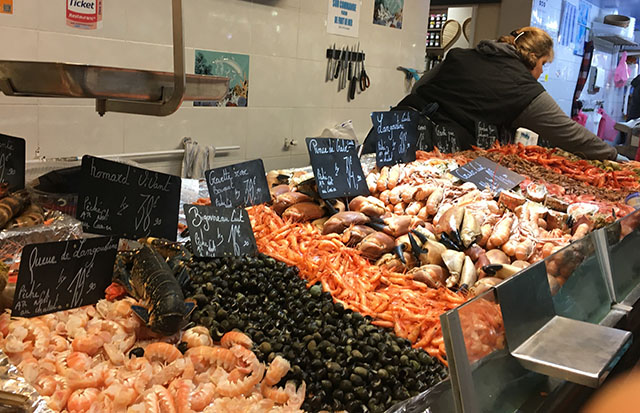


French Grammar – The Gender of Nouns – le, la, l’, les, un, une, des
No matter how long one studies French, the definite and indefinite articles seem to be a challenge for all. Even though they can be directly translated from English to French, there are situations where these articles are not used in quite the same way. As a general rule, in French, there is almost always an article in front of a noun. Unlike English, where you can get away with...Read More
French Grammar – French Verbs that Look the Same But Are Different
Our students and all French learners are often confused by a few French verbs that look quite similar, but have a different meaning. Here are a few of these pairs that are very commonly used in French. I. Penser vs Croire Penser mainly means “to think”, whether it is followed or not with the conjunction “que”. There are slight nuances when it is followed by the...Read More
French Grammar – Using the Verb Manquer
The Verb manquer : Different Meanings Not to Be Missed This verb is very interesting as it means at the same time “to lack” or “to run out of something”, to “fail”, and, its main meaning, “to miss”. And this is when it becomes very confusing for English speakers as it is used in a very different way. It is interesting, too, to discover a...Read More
Que vs Quoi, Quel, Quelle, Qu’est ce que in French: Complete Guide + Examples
You might be a beginner or have been learning French for a while and you’re still unsure about the correct French interrogative expression for ‘what’ or ‘which’. Que, quoi, quel(s), quelle(s) or qu’est-ce que (qui) ? Which one should you use? 1. Quel(le) There are 2 ways to use quel: a) With a noun to express “what” or “which” A noun needs to follow after the...Read More
French Grammar – Using “On” instead of “Nous”
“On”: Friendlier than “Nous” The tiny word on carries great importance in everyday spoken French. For Anglophones learning French, on is frequently misunderstood or ignored because many think that on only expresses its English equivalent of ‘one’, while many of those who understand that it’s also an alternative to using nous hesitate to use it because of the false belief...Read More
Plus-que-parfait in French: Conjugation, Usage + Examples
What is the Plus-que-parfait? The plus-que-parfait expresses an action that occurred before another past action. It’s the “past of the past” in French. Structure: Imparfait of avoir/être + past participle Example: J’avais fini (I had finished), Elle était partie (She had left) Think of it this way: If the passé composé is “I ate,” the...Read More
How to Use The French Verb “Prendre”
Quick Summary: Core meaning: “to take” — but also “to have” (food/drinks), “to catch”, “to get”, and much more Irregular verb: Je prends / Nous prenons / Ils prennent Key tip: In French, you never “have” a coffee — you “take” one (je prends un café) Derived verbs: apprendre (to learn), comprendre (to understand),...Read More
How to Express Your Opinion in French
In France, there are not many subjects that are considered taboo, and the French will frequently speak their mind without holding back. At a dinner party in France, you might be asked to share your opinion on your political beliefs, relationships, spiritual tendencies, the environment, immigration, etc. In discussions, there is one topic that many avoid which is people’s finances or...Read More
French Grammar – L’incroyable verbe “passer”
If you spend a day listening to French people speaking to one other, you will hear the verb passer over and over. It is an extremely rich verb and probably one of the most important ones to master since it is used in so many everyday life contexts. Passer also has the particularity to take either the auxiliary avoir or être in the passé composé depending on its meaning. 1. Passer du...Read More